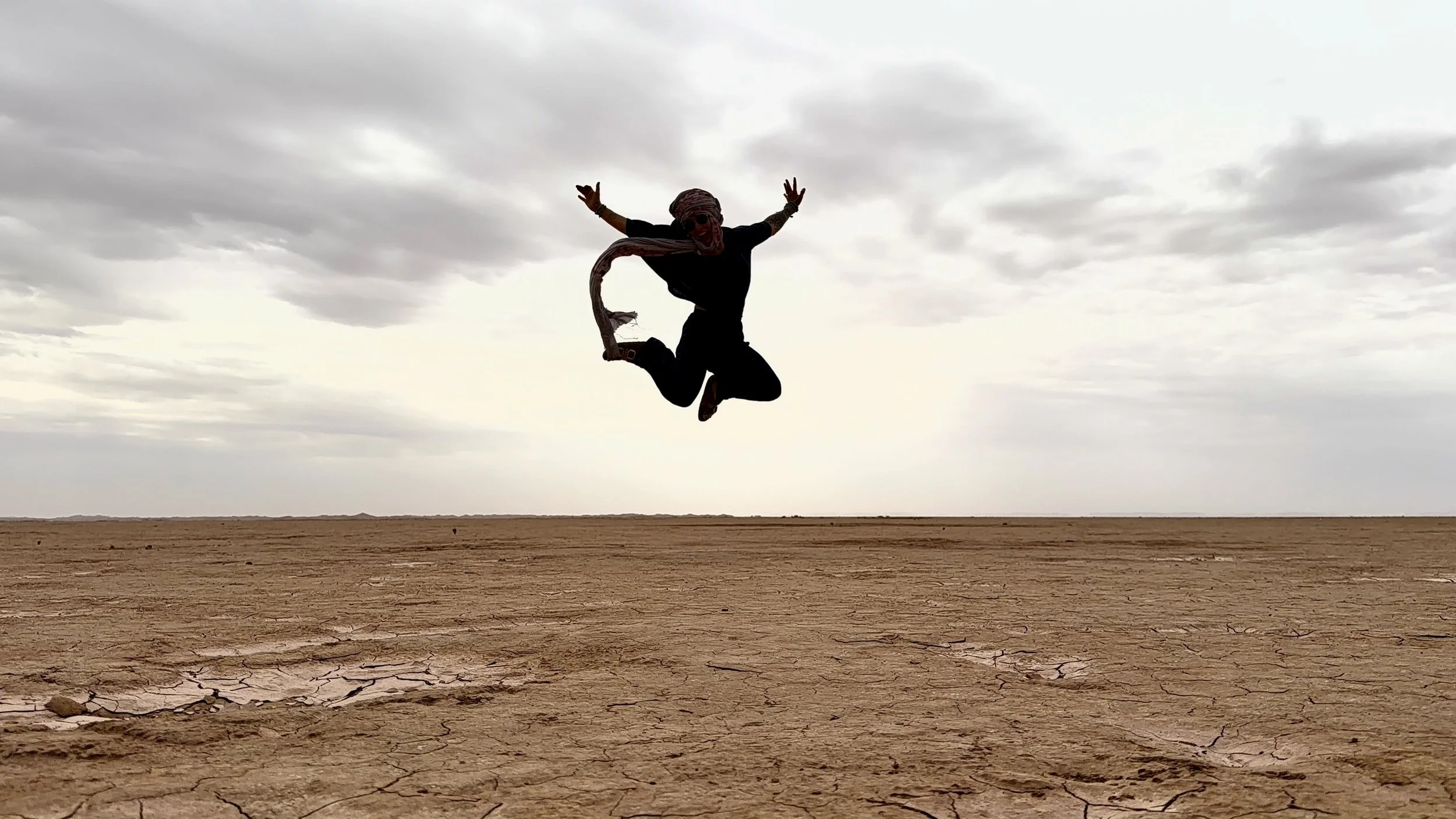
Morocco Slaps You Awake: What Happens When Women Step Out of the Comfort Crisis
They left yesterday.
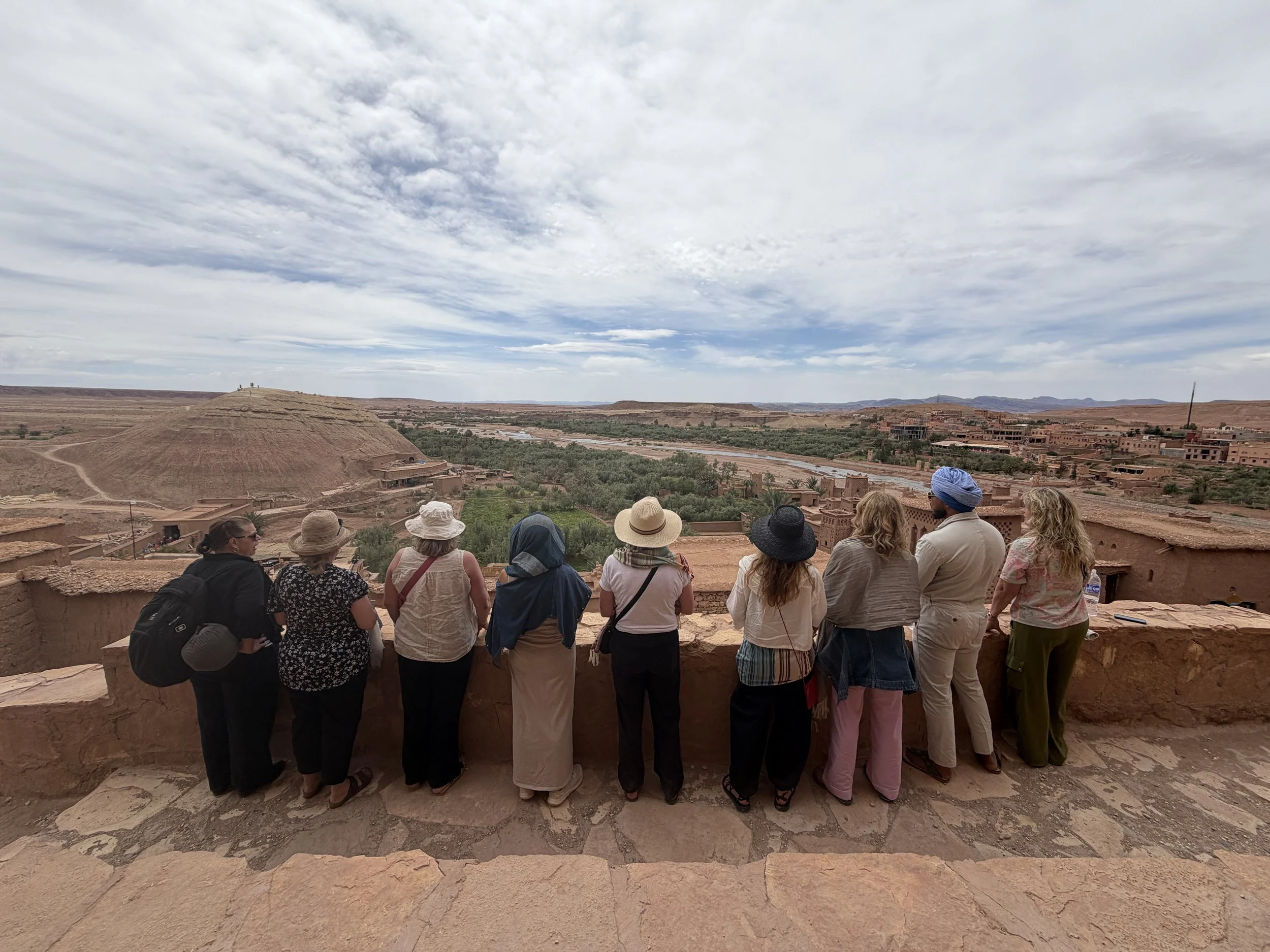
Nine women. Bags stuffed with kaftans and rolled carpets and extra luggage purchased somewhere between Marrakech and the Sahara because there was simply no other option. And sand. Little golden flecks of it are still working their way out of everything. Shoes. Scarves. The corners of their soul, parts that have not been unpacked yet.
Morocco does that.
It follows you home. It tucks itself into the folds of things and reminds you, quietly and persistently, that you were there. That it was real.
I said my goodbyes in Marrakech yesterday and gave myself a few quiet days in a riad before flying home. I wandered the souks alone, exhausted in that satisfying, soul-deep way that only comes after you have fully lived something. I stopped for a long lunch by myself and got a massage. I went to bed early and slept for nine and a half hours straight.
This morning, I am sipping coffee in bed, listening to the muffled sounds of the Medina beyond the walls, letting the whole experience slowly settle into my bones before the ordinary world rushes back in.
And sitting here in the stillness, I keep returning to something a friend of mine wrote recently that I have not been able to shake.
My friend and writer Candace Sampson published a piece that gave me pause. She had come across a term and traced it back to ecologist and conservationist Robert Pyle, who first named the concept of “extinction of experience” in his 1978 book The Thunder Tree. Pyle used it to describe the growing disconnect between people and the natural world. The idea that as direct, sensory, unmediated experience disappears from our lives, so does our capacity to care about what we are losing. Not just nature. Each other. Ourselves.
[Candace's piece is worth reading in full. Link here.]
I read it, and the idea stayed with me the entire trip.
Because what I witnessed over the last two weeks felt like the direct opposite of the extinction of experience.
I watched nine women step out of the comfort crisis and back into the real world, into discomfort and awe and sensory overload and deep human connection. I watched them come alive in real time.
I spent two weeks watching them prove the antidote exists.
We Are Living Through a Comfort Crisis
I say this often because I believe it is the quiet emergency of our time. We have optimized, padded, and safety-wrapped our lives to the point where almost nothing is required of us anymore. Nothing unexpected. Nothing uncomfortable. Nothing we have not already pre-approved.
We move from temperature-controlled homes into temperature-controlled cars. We pre-screen conversations. We order everything to the door. We reach for our phones before boredom ever has the chance to become curiosity or wonder or the kind of restlessness that once sent people outside.
And the cost of all that comfort is that we stop feeling things.
Not all at once. It is slow and cumulative. One day, you simply notice the colour has turned down a little. That you are living your life while somehow watching it at the same time.
This is what Pyle was mourning. Not drama. Erosion.
If any of that feels familiar, keep reading.
Morocco Slaps You Awake
Morocco does not do glass.
We started in Marrakech. The Medina. And if you have never been, nothing I write here will fully prepare you, which is exactly the point.
You step through a doorway, and the city is immediately, completely, unapologetically on you. The sound of vendors and motorbikes and a donkey you absolutely did not see coming. The smell of leather tanneries and cumin, and something sweet you cannot place. Colour layered on colour until your eyes cannot find an edge to rest on.
I say this to every group I bring here: Morocco slaps you awake.
You have to watch where you put your feet on the uneven stone. You are dodging motorbikes and donkeys from directions you did not anticipate. The spices hit you before you even see the stall. Every sense you have been quietly letting atrophy in the cushioned routine of regular life comes gloriously online.
You are not observing the world from behind a screen. You are navigating it with your whole body.
And there is a version of yourself, one you may not have heard from in a very long time, that lights up the moment it gets the chance.
These women lit up. Every single one of them.
There was laughter. So much laughter. The kind that starts somewhere in the belly and keeps coming. The kind you forgot you were capable of. They talked constantly. Stories unlock other stories. Conversations that could never have happened over text or across a dinner table at home because this place had cracked something open, and what poured out was real and unpolished and alive.
That is what happens when you remove the performance.
So much of modern life is performance. The curated version online. The composed, capable version at work. The version that is fine.
Morocco has no interest in fine.
It reaches past all of it and finds the actual woman underneath.
And the actual woman, it turns out, has been waiting.
What the Atlas Mountains and the Sahara Teach You
In the High Atlas Mountains, the roads narrow and the villages cling to the rock as though they grew there, which in every way that matters, they did. Generations of people who understood that the land is not a backdrop but a relationship.
Something in that lands differently when you are standing inside it rather than looking at a photograph of it. You feel it as a quiet accusation. All the beauty you have been consuming through a screen, while the real thing existed out here all along.
At the oasis, we stopped. Not to photograph it. To stand in it. To feel how the air changes when water appears in the middle of all that heat and stone. To let the body understand what the mind already knew.
This is why people crossed deserts. Why they built lives in hard places. Why they carried so much so far.
Because the things worth having require the going.
And then the Sahara.
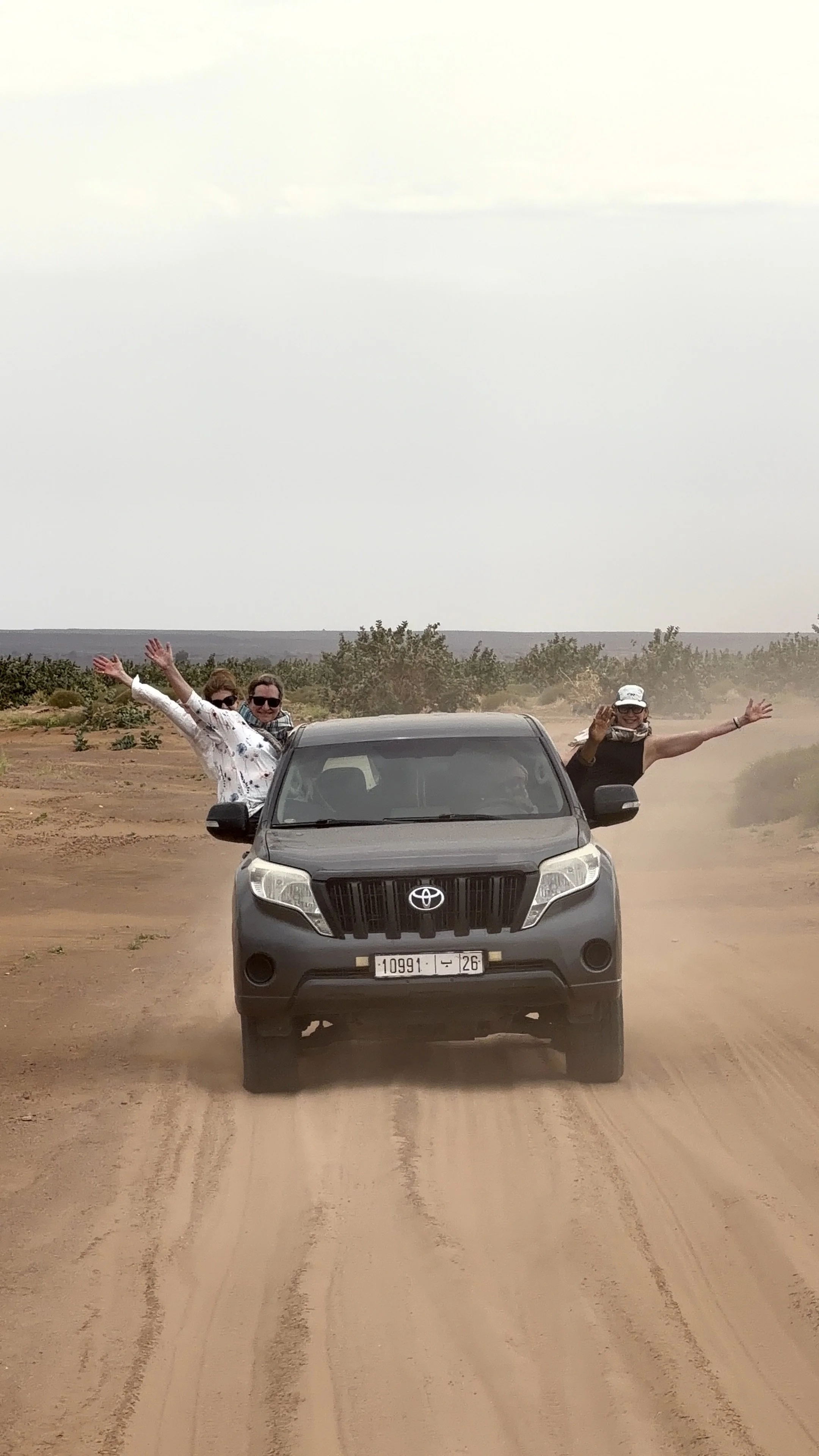
We followed the old spice routes, the same paths caravans walked for centuries, carrying saffron and cinnamon and stories from one end of a continent to the other.
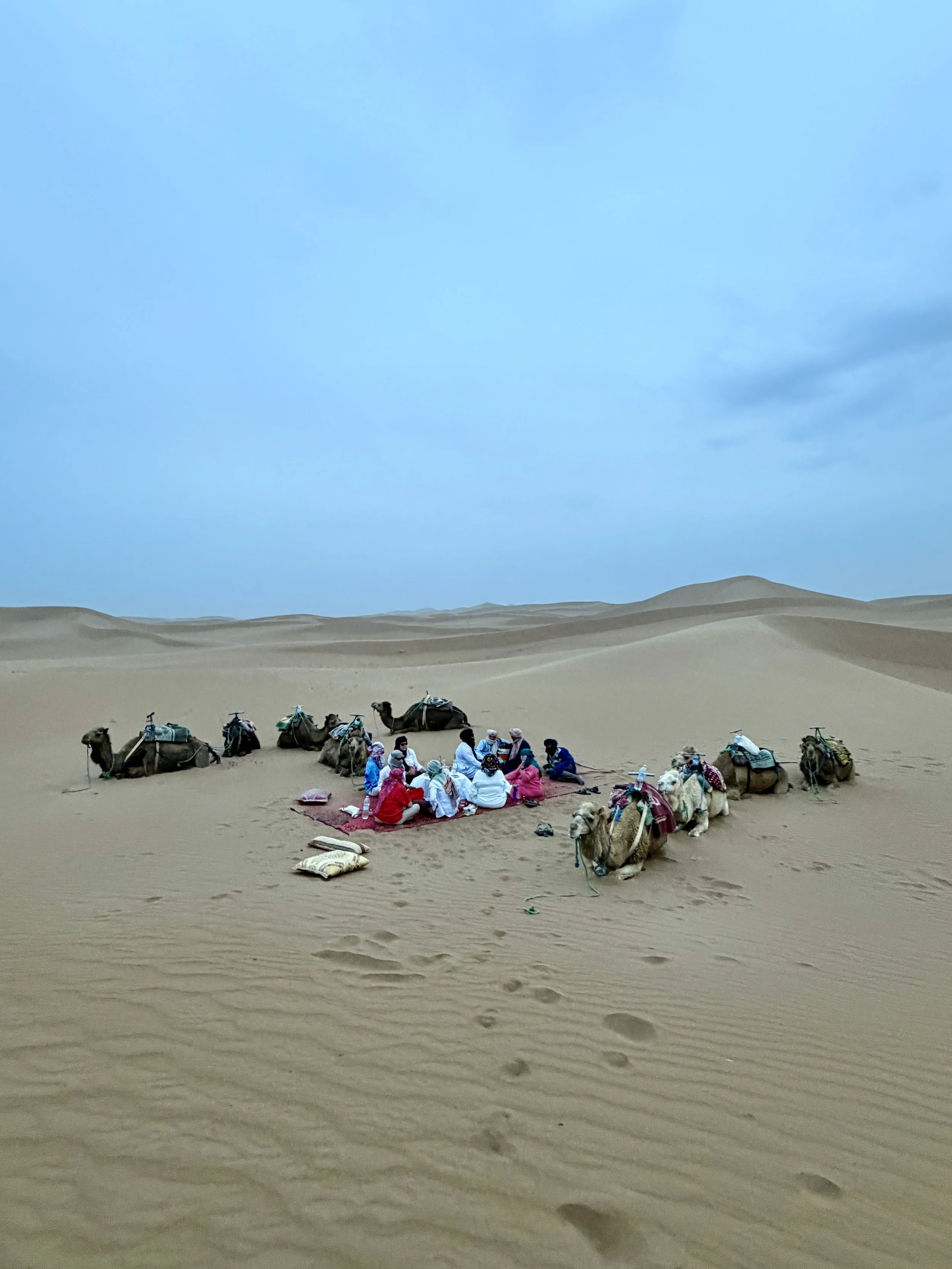
We rode camels through a sandstorm. Mild by desert standards, but a sandstorm nonetheless. Gritty and golden and completely real.
The dunes rose around us in every direction until there was nothing left but sand and sky. No roads. No buildings. No sense of where the world outside the desert even was.
And then, somehow, in the middle of all that wildness, there they were.
Picnic rugs unfurled between the dunes. Low tables. Poofs pressed into the sand. Little dishes of snacks appearing as bottles of wine were poured into waiting glasses while the wind moved steadily across the desert around us.
Sand gathered in the folds of our clothes and settled into the wine glasses, and nobody cared.
In fact, I think they loved it more because of it.
There are not always sandstorms in the Sahara. But if the desert was going to hand one to a group, I cannot imagine a better group of women to receive it. They met the whole thing with laughter and open hearts and the kind of willingness that cannot be manufactured.
Nobody wanted to turn back.
They leaned in. All of them. Laughing, eyes bright, fully inhabiting the extraordinary thing that was happening to them.
Leaning into the sandstorm.
I keep thinking about that image. Women who had spent years bracing against discomfort were suddenly leaning toward it instead.
That is not a small thing.
That is everything.
Direct Experience Doesn't Just Enrich Us. It Corrects Us.
We visited a nomadic family deep in the desert. A woman opened her tent to us, offered tea, offered warmth, offered the particular hospitality of people who have never had much and give freely anyway.
An Australian woman in our group looked around the tent, took it all in, and in the most Australian accent imaginable said:
“These people are fucking awesome.”
We all burst out laughing. But underneath the laughter was something else. Something cracking open.
Because over and over again across Morocco, this is what we encountered.
Warmth. Generosity. Humour. Pride. Hospitality so instinctive and genuine it constantly caught people off guard.
Tea was poured before you could ask for it. Hands placed over hearts in greeting. Shopkeepers invite us to sit and talk. Strangers helped when we looked lost in the Medina. Families opening their homes and tents to us and offering whatever they had without hesitation.
And this is what direct experience does.
The world we are fed through screens is flattened. Filtered and framed and reduced to headlines and fear and assumptions. A position. A side. A threat. A symbol.
And then you actually go somewhere.
You sit cross-legged in a nomad tent drinking tea with people who welcome you like family, and suddenly the story becomes human again.
Every preconception you were carrying without even knowing it falls quietly away.
This is what Pyle understood.
Direct experience does not just enrich us. It corrects us.
It is almost impossible to hate what you have truly encountered.
We lose that when we stop going. When the world shrinks to the size of a screen. When comfort becomes the highest value and experience becomes optional.
That is the extinction Pyle named. That is what I see spreading. That is what I have dedicated this work to interrupting.
And if I am honest, this group reminded me of something, too.
Hosting these journeys asks a great deal of me. There are long days and endless moving pieces, and the particular kind of exhaustion that comes from holding space so fully for other people's experiences.
But then there are moments like this past week.
Women standing barefoot in the Sahara with wind in their hair and sand in their wine glasses, laughing so hard they can barely catch their breath. Faces lit up with genuine awe. Strangers becoming deeply known to one another in the span of days.
And I remember exactly why I do this.
Not because travel is luxurious or beautiful, though often it is. But because I get to watch women come alive again in real time.
There is no exhaustion that outweighs the privilege of witnessing that.
They Came Home Different. That Was the Whole Point.
They are on their way home now, all 9 of them, carrying golden sand they will be finding for months. Carrying carpets they have no idea where to put and kaftans they will wear until they fall apart. Carrying 9 new women in their lives who now know things about them that only shared, real, unscripted experience can reveal.
And carrying something harder to name.
A recalibration. A remembering. The particular kind of quiet confidence that comes not from being comfortable but from discovering you do not need to be.
The Medina feels quieter now. The laughter has faded into the traffic, the tea glasses have been cleared, and the desert somehow followed us home. Some women boarded planes. Some carried the adventure onward. But for a little while, in the winding streets of Morocco, strangers became a tiny moving family.
And somehow, without them here, even the Medina feels as still as the Sahara.
That is what Morocco gives you. It is what travel at its best has always given. Not escape from your life but a way back into it. Not a break from yourself but a return to yourself. The one who lights up when the world is suddenly, undeniably, gloriously real.
I am sitting in a riad in Marrakech listening to the city outside the walls and thinking about all of them, scattered now across airports and time zones, carrying their sandy bags home.
And I am thinking about you, if you are reading this, and something in it feels familiar. If you recognize that muted feeling. If some part of you knows it has been too long since something truly slapped you awake.
Morocco will do it.
I promise you that.
Grit & Grace Adventures exists for exactly this. Not to take you away from your life, but to give it back to you.
Morocco is calling.
We go back in April 2027.
And truthfully, these journeys often begin filling before I ever officially launch them. Many of my retreats sell quietly through the waitlist long before they make it to social media or the website.
So if your nervous system just whispered “oh hell yes” while reading this, I would listen to her.
Bslama for now.
Penny
xo