

You step out of the airport, and it hits you before you have found your bag. The air is different. Thicker, sweeter, smokier, something you cannot name yet. The horns have a rhythm you do not understand. A woman is frying something at the corner, and you have no idea what it is, only that you want it.
That is the gift of travel. Every corner is a question. Turn one, and there is a temple. Turn another, and there is a goat, a wedding, a man selling marigolds by the kilo. Your senses wake up because nothing is automatic anymore. You cannot sleepwalk through a place you do not know.
And then one day you come back.
I am writing this from Kathmandu, and I have come back. The first time I was here, I was doing my first hour yoga teacher training. When it ended, I walked up the Khumbu to Everest Base Camp and kept going to Kala Patthar, the black rock above it where the whole face of Everest finally shows itself. I did that trek in silence. Days of it. No small talk, no narrating the view to anyone, just breath and boots and the sound of yak bells. It was the clearest my mind has ever been, before or since.
This week I stepped out of the same airport and the air hit me again, but this time my body said, oh, there you are. The incense, the diesel, the dust after rain. The bells at dawn. The particular way the light lands on a courtyard wall. I did not know I had kept any of it. It was folded away somewhere deeper than memory. Not in my head. In my skin.
It is still other. It still surprises me. But now it recognizes me, and I recognize it. The strangeness and the belonging live in the same breath.
That, I think, is the whole point. Go somewhere that unsettles you. Then go back, and discover it has become part of you.
Why I am telling you this today
The women of Bhutan 2026 are arriving in Kathmandu a few at a time. Some came early to see the city, some to breathe at altitude before we fly over the Himalaya to Bhutan on Friday.
I will tell you how to come at the end. First, let me tell you about Bhutan. Because the happiest place on earth is the least interesting thing about it.
The country built on a sleeping giant
In the 600s, a Tibetan king wanted to build a temple in Lhasa, and the ground kept swallowing the work. His wife, a geomancer, saw the problem. The whole Himalayan landscape was a giant ogress (a female ogre: in folklore, a giant, usually monstrous being, often said to eat people. In the Tibetan legend, the word stands in for the srinmo, a huge female demon lying across the whole Himalayan landscape, hostile to Buddhism until the temples pinned her down) lying on her back, and nothing would stand until she was pinned down. So the king built thirteen temples across her body in a single day. Two of them landed in Bhutan. Kyichu Lhakhang in Paro holds her left foot. Jampey Lhakhang in Bumthang holds her left knee.
Both temples are still standing, and we visit both. Your guide will tell you this story on the steps of Kyichu, and once you have heard it you will never look at a prayer flag the same way. In Bhutan, the land is alive, and everything built on it is placed to keep it in balance.
The lama who became a country
A century after those temples, a saint called Guru Rinpoche flew in on the back of a tigress and meditated in a cliff cave above Paro. That cave is the Tiger's Nest. He is the reason Buddhism took root here, and his face is in every temple you will enter.
But Bhutan as a nation was built by one man in the 1600s. Zhabdrung Ngawang Namgyal fled a religious quarrel in Tibet, arrived in 1616, and over thirty-five years turned a scatter of warring valleys into a country. He fought off Tibetan invasions, built the great fortress monasteries you will walk through in Punakha and Thimphu, and wrote the laws and the dress code that people still wear to work today.
Then he died, and his ministers hid it for fifty years.
They announced that he had gone into deep retreat and must not be disturbed. Food was carried to his sealed room every day. The new country was too fragile to lose him, so they simply did not let him go. It held Tibet at bay for half a century. When you stand in the courtyard at Punakha Dzong, you are standing where the kingdom's best-kept secret was kept.
I will be honest, I have read about that sealed room more than once, and I am still not sure it is a tragedy. Meals at the door, nobody allowed to disturb you, fifty years. Ours is eleven days, the food is better, and you get to leave the room. But if anyone asks where you are next November, tell them you have gone into deep retreat and must not be disturbed. It worked for him.
The king who gave his power away
Bhutan still has a king, and the royal family is loved in a way that is hard to explain until you see the photographs in every shop and every home. The fourth king is the one who, in the 1970s, said a country should measure Gross National Happiness instead of GDP. That line has travelled around the world. What travelled less is what he did next.
In 2006 he stepped down in favour of his son, and in 2008 he gave up absolute power and handed the country a constitution and an elected parliament. Many Bhutanese did not want it. They trusted their king. He did it anyway, because he believed a country should not depend on getting a good king by luck.
I think about that a lot. A man with everything, choosing to need less of it.
Why there are only ever a few of us
Bhutan opened to visitors in 1974 and made a decision most countries never have the nerve to make. High value, low volume. Every visitor pays a daily fee that goes to schools, hospitals and forests, and in return the trails are quiet, the temples are temples and not attractions, and the person serving your lunch is not exhausted by tourism.
I understood this properly on the morning I built the whole trip around.
The morning in the crane valley
Every November the black-necked cranes leave the Tibetan plateau, fly over the Himalaya, and land in one high valley called Phobjikha. The people there have never farmed the marsh where the cranes feed. They say the birds circle the monastery three times when they arrive and three times when they leave, and the valley takes them at their word.
On 11 November the whole valley walks up to Gangtey Monastery to welcome them. Children in crane costumes. Masked dancers. Grandmothers with thermoses. It is cold and bright, and nobody is in a hurry, and somewhere out on the marsh the actual cranes are standing in pairs, ignoring all of it.
It is one of the quietest, strangest, most moving mornings I know of anywhere, and it is the reason Bhutan 2027 runs when it runs. We will be standing in that crowd.
The rest of it
Before the cranes, the Punakha valley. A stretch of the old Trans Bhutan Trail with a picnic at the Divine Madman's house. A bow in your hands at a village archery match, which is louder and funnier than you are imagining. Evening prayers with the nuns of Sangchhen Dorji Lhuendrup, where the chanting does something to your breathing that I have never been able to explain. And a farmhouse kitchen where we cook ema datshi and red rice and then sit down and eat it with the family.
After the cranes, Bumthang, where the oldest temples are, and where the Burning Lake is, and where the nuns of Pema Choling sing for us. Then a short flight back west, and on the last full day the climb to the Tiger's Nest. There are ponies for the first half for anyone who wants one. There is tea at the top for everyone. And there is a moment, about two-thirds of the way up, where the monastery comes into view across the gorge and the whole group goes quiet without anyone asking them to.
Two nights in every lodge, so nobody packs at dawn. Bhutanese-owned, all of them. Two Bhutanese guides who are ours for the whole journey. Ten women. Never more.
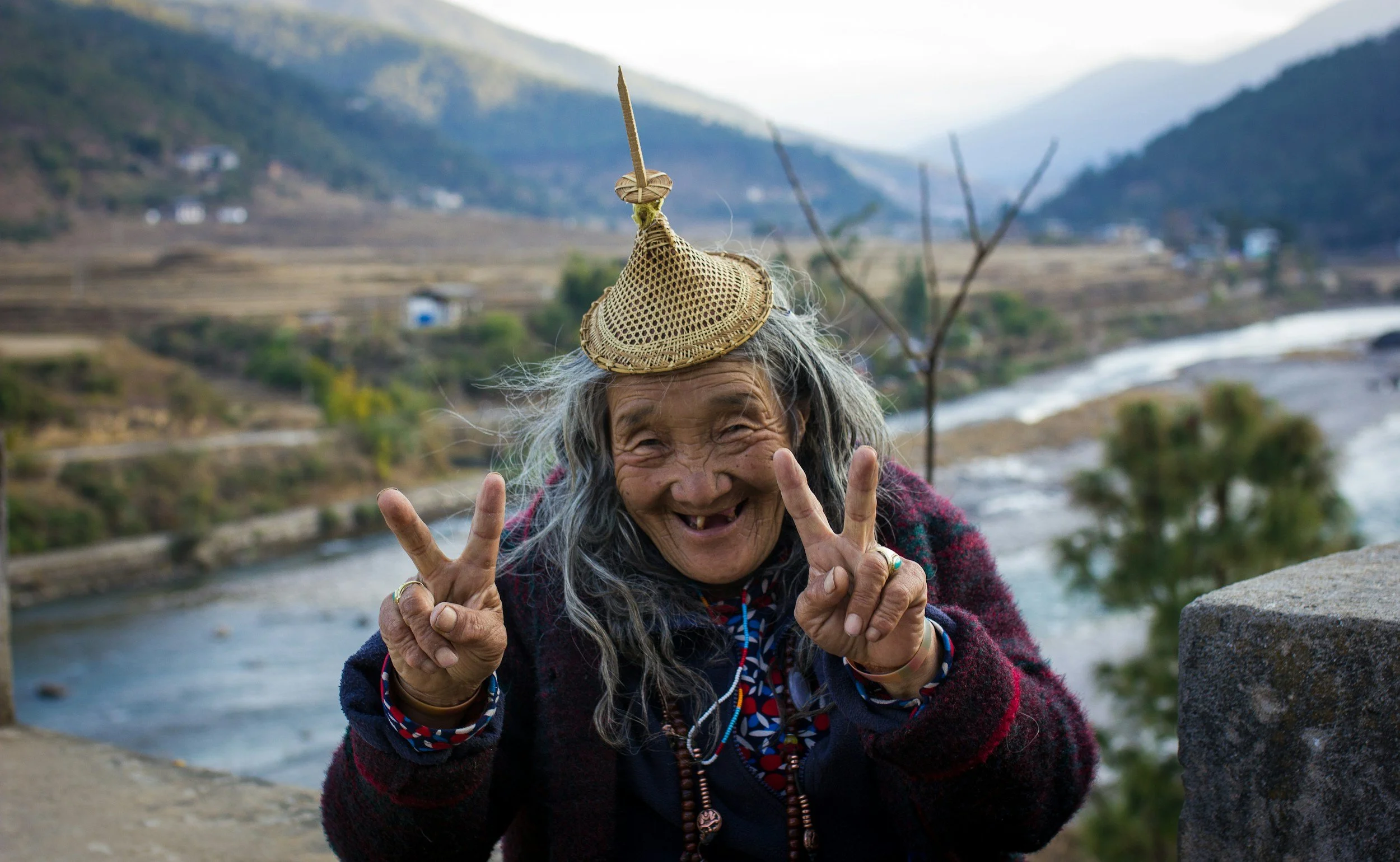
I am on a mission to find this awesome lady…
The familiar in the otherness
Here is what I have noticed, watching women step out of airports for fifteen years. The first time, the place takes you apart a little. The air, the noise, the not knowing. You spend the first two days with your senses turned all the way up.
And then something settles. By the fourth day you know which bakery, which bell, which dog. By the last day you are the one telling the new arrival where to find the good coffee. The strangeness and the belonging live in the same breath, and you carry both home.
I came back to Kathmandu, and my body knew it before I did. I think the women landing here this week will come back to this area of the world one day and feel the same thing. Some of them are already asking.
Bhutan 2027 is open. I offered it to my waitlist first, and five of the ten places went in two days, so there are five. If one of them is yours, the full itinerary and the practical things are on the trip page. If you want to talk it through first, write to me. I am in Kathmandu this week and Bhutan next, so I may be slow, but I will answer.
Go somewhere that unsettles you. Then go back.
Penny